
I had never even heard of Inkling until yesterday, when DHH posted this on X showing that Thinking Machines Lab’s Inkling 2 Mini had just beaten Qwen3.8 27B (and crushed Nemotron 3.5 Bolt) in his overnight Omarchy malleability shoot-out on an RTX Spark: an 8.50 average vs 8.00, finishing 8 of 8 runs in 142 minutes versus 240 minutes for Qwen.
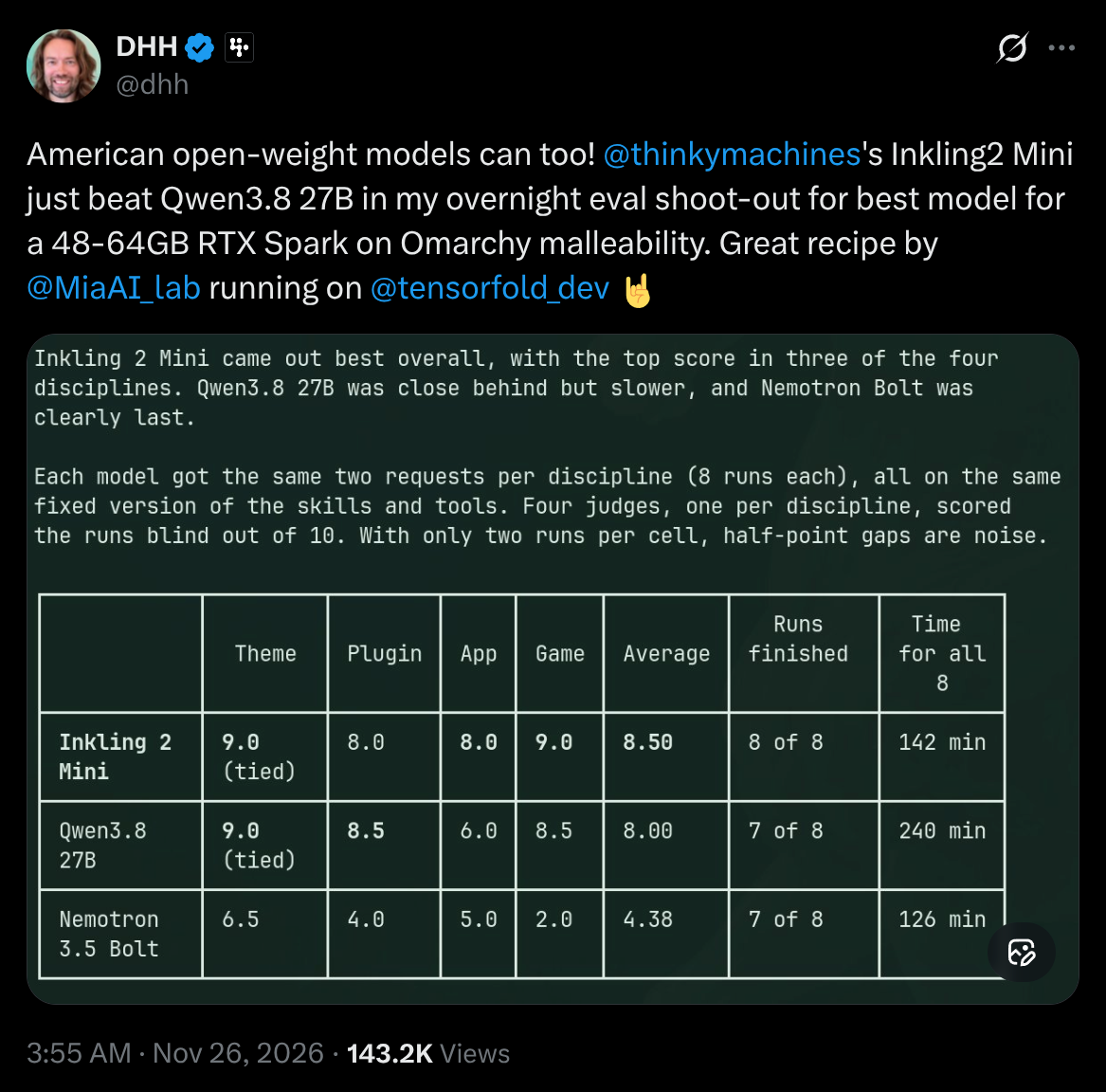
It has been almost exactly a month since I published my open-source LLM benchmark for home hardware, where Qwen3.8 Flash-Next running on Basalt claimed the crown on my RTX 5090. DHH’s post immediately caught my attention: if this new 26.4B model beats dense Qwen3.8-27B in his shoot-out, how does it hold up against the reigning champion on my own desk? In llm-opensource-benchmark, I pitted Inkling 2 Mini directly against Qwen3.8 Flash-Next (a much larger 125B total / ~6B active MoE, quantized to Q2_0 and IQ3_S) on both my RTX 5090 and my AMD Strix Halo.
Who built Inkling 2 and what is its story
Inkling 2 comes from Thinking Machines Lab, the AI startup founded in early 2025 by former OpenAI CTO Mira Murati alongside a veteran roster of former OpenAI researchers. After months of building training infrastructure and its Tinker platform, the lab released its second generation of open-weight models in November 2026 under the permissive Apache 2.0 license: first the cloud-scale Inkling 2 Small (a 594B total / 17B active multimodal MoE), followed on November 20 by Inkling 2 Mini on Hugging Face (thinkingmachines/Inkling-2-Mini), built specifically to run locally on 32 GB laptops or a single desktop GPU.
The reason Inkling 2 Mini punches so far above its size comes down to its architecture. Instead of stacking more physical layers and blowing past consumer VRAM, Thinking Machines built a depth-looped MoE Transformer:
- Parameters: ~26.4 billion physical total parameters, with only ~3.4 billion unique active parameters per token (roughly ~5.4 billion effective active parameters when counting the repeated passes).
- The depth-loop trick: the model has 24 physical decoder layers. Layers 0 through 5 run once, the middle 12 layers (6 through 17) loop three times sequentially per token reusing the exact same weights, and layers 18 through 23 run once. You get the logical depth of a 48-layer model inside a compact memory footprint.
- Format and context: it ships in native mixed NVFP4/MXFP8 precision (~20 GB on disk), handles text and image inputs natively, and supports up to a 1 million token context window.
What the creators claim and their published numbers
Thinking Machines Lab’s pitch is straightforward: bring near-frontier reasoning, tool use, and agentic software engineering into an offline package that fits inside a 32 GB MacBook Pro or an RTX 5090. Looking at their launch benchmarks (measured against dense Qwen3.8-27B), the model’s profile is unmistakable:
| Benchmark | Inkling 2 Mini | Qwen3.8-27B (dense) | What it measures |
|---|---|---|---|
| SWE-bench Verified (bash-only) | 79.2% | 77.8% | Autonomous bug fixing in real repositories |
| SWE-bench Pro v2 (Hard) | 77.9% | 73.8% | Advanced software engineering tasks |
| DeepSWE v1.1 | 48.2% | 42.2% | End-to-end repository-level resolution |
| SWE-bench Multilingual | 73.7% | 70.0% | Cross-language code fixing |
| PMPP-Hard (Kernel Opt. AUC) | 455.82 | 262.50 | Low-level kernel optimization |
| Terminal Bench v2.1 | 71.6% | 73.0% | Command-line and terminal operations |
| Artificial Analysis Index v5.0 | 20.1 | 20.1 | Composite intelligence index |
| AutomationBench-AA v1.0.6 | 41.8% | 48.2% | Office and enterprise workflow automation |
| AA-Briefcase v1.1 (Elo) | 1263 | 1391 | General knowledge work and document tasks |
They also reported strong tool-use and multimodal scores (82.7% on MCP Atlas, 85.3% on DeepSearchQA, 76.5% on ScreenSpot Pro, and 92.8% on OmniDocBench).
Notice the trade-off already visible in the lab’s own numbers: on coding, debugging, and kernel optimization, Inkling 2 Mini beats dense Qwen3.8-27B almost across the board. On broader office workflows and static world knowledge (AutomationBench and AA-Briefcase), the 27B dense model holds the edge, because 27B dense weights store more static facts than a 3.4B-active sparse MoE, even with depth looping.
My real-world tests: RTX 5090 and AMD Strix Halo
Every lab publishes flattering launch charts. I pulled Inkling 2 Mini into the exact same llm-opensource-benchmark suite on my two home machines, driving OpenCode inside a bubblewrap sandbox:
- RTX 5090 desktop (32 GB VRAM): keeping 4 GB free for the desktop (Hyprland, browser, and terminal), tested on both Strata (
0.1.69,SQ-20pack) and Basalt (v0.5.7, nativeInkling-2-Mini-NVFP4-MX8.basalt), against Qwen3.8 Flash-Next (Q2_0,IQ3_XXS,IQ3_S, andUD-Q4_K_XL). - AMD Strix Halo (headless, 64 GB VRAM + 31 GB GTT): full GPU dedicated to the model, using Strata’s HIP backend (
0.1.67for Inkling 2 Mini).
Speed on the RTX 5090: Strata vs Basalt
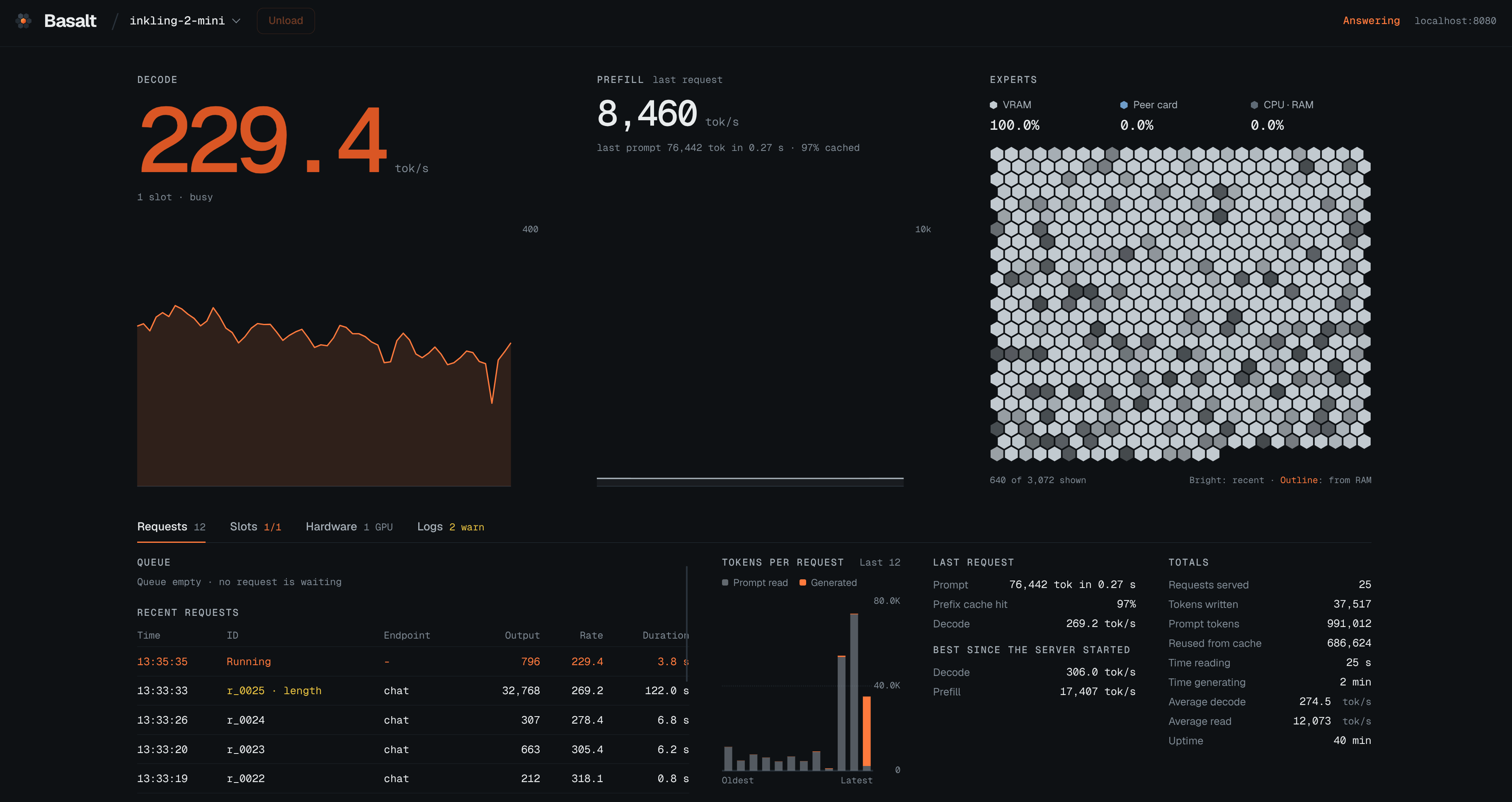
Numbers come from the speed canary (cold 4k and 32k prompts plus a cached 32k follow-up, 131k context window):
| Engine | Model / Version | Output (tok/s) | 32k Prefill (tok/s) | 32k TTFT | RAM offload | Min free VRAM |
|---|---|---|---|---|---|---|
| Basalt v0.5.7 | Inkling 2 Mini (NVFP4-MX8) | 250 to 346 | 15,577 | 2.1 s | 0 GB | 6.57 GiB |
| Basalt v0.2.1 | Qwen3.8 Flash-Next (Q2_0) | 377 to 400 | 8,600 | 4.9 s | ~30 GB | 4.13 GiB |
| Basalt v0.2.1 | Qwen3.8 Flash-Next (IQ3_S) | 223 to 231 | 8,200 | 5.2 s | ~42 GB | 4.35 GiB |
Strata 0.1.69 | Inkling 2 Mini (SQ-20) | 110 to 154 | 6,489 | 5.1 s | 0 GB | 4.98 GiB |
Strata 0.1.50 | Qwen3.8 Flash-Next (Q2_0) | 245 to 270 | 6,200 | 7.0 s | ~30 GB | ~4.0 GiB |
Strata 0.1.50 | Qwen3.8 Flash-Next (IQ3_S) | 160 to 210 | 6,200 | 7.0 s | ~42 GB | ~4.0 GiB |
Strata 0.1.50 | Qwen3.8 Flash-Next (UD-Q4_K_XL) | 44 to 52 | 2,300 | 19.0 s | ~75+ GB | OOM on quality |
Speed on the AMD Strix Halo (Strata HIP)
| Model / Version | Output (tok/s) | 32k Prefill (tok/s) | 32k TTFT | Min free VRAM | Quality Canary |
|---|---|---|---|---|---|
Inkling 2 Mini (SQ-20, 0.1.67 HIP) | 13.8 to 24.8 | 642 | 51.1 s | 41.9 GiB | 100 (6.2 min) |
Qwen3.8 Flash-Next (Q2_0) | 55 to 65 | 371 | 114.1 s | 22.1 GiB | 100 |
Qwen3.8 Flash-Next (IQ3_XXS) | 50 to 57 | 347 | 122.0 s | ~12 GiB | 100 |
Qwen3.8 Flash-Next (IQ3_S) | 47 to 51 | 338 | 125.4 s | 5.4 GiB | 100 |
Qwen3.8 Flash-Next (UD-Q4_K_XL) | 17 (4k) | 137 | hung machine | 0 GiB | did not fit |
Coding quality: Hard Canary on the RTX 5090 (Basalt)
On the quality canary (3 turns, 9 hidden tests), every model scored 100 (Inkling 2 Mini finished in 2.1 minutes on Basalt 5090 and 6.2 minutes on Strix Halo). The real separation comes from the hard canary: a 4-turn OpenCode session on a payment reconciler graded by 36 hidden tests, with decisions buried inside a 64k-token transcript (including one reversed later), cent-exact decimal arithmetic, and a final refactor. I ran each model three times on Basalt:
| Model (Basalt 5090) | Scores (3 runs) | Hidden tests | Avg wall time (4 turns) | Output tokens per run |
|---|---|---|---|---|
Inkling 2 Mini (NVFP4-MX8) | 100 / 100 / 100 | 36/36 on all 3 | 9.8 min (8.5 / 8.2 / 12.7) | 140k to 204k |
Qwen3.8 Flash-Next (Q2_0) | 100 / 100 / 100 | 36/36 on all 3 | 5.5 min (5.9 / 4.2 / 6.3) | 78k to 116k |
Qwen3.8 Flash-Next (IQ3_S) | 100 / 96* / 100 | 36/36 on all 3 | 9.1 min (5.8 / 11.3 / 10.1) | 61k to 121k |
* On IQ3_S run 2, all 36 hidden tests passed. The 4 deducted points were a sandbox snooping false alarm triggered when the model ran ps aux (a harness bug since fixed).
The test that actually separated them: Benchmark v3 (18 multi-language tasks)
Because both Inkling 2 Mini and Qwen3.8 Flash-Next saturated the hard canary at 100 / 100 / 100, I needed a much harsher yardstick to see where each model starts to crack. I stepped up to benchmark-v3 (from my llm-coding-benchmark repo) running inside the exact same network-isolated bubblewrap sandbox, with read-only Python, Ruby, Go, and Rust toolchains, a 15-minute (900 s) timeout per task, and both models served via Basalt on the RTX 5090: Inkling 2 Mini (NVFP4-MX8) against Qwen3.8 Flash-Next (IQ3_S).
benchmark-v3 grades correctness depth, where any tests the model writes itself count for zero points. Every score comes strictly from hidden, adversarial test suites the agent never sees, weighted heavily toward edge cases (empty inputs, overflow, unicode, concurrency, malformed data) alongside hard root-cause, regression, and performance gates. The 18 deliverables span:
- Root-cause debugging and safe refactoring in Ruby:
01-debug-paginatorand05-refactor-pricing. - Adversarial edge cases in Go and performance in Rust:
02-edge-csvand04-perf-intervals. - Invariants, ambiguity traps, performance, and recovery in Python:
03-invariant-eventlog,06-ambiguity-emails,08-perf-rangesum,09-sabotage-recover, and14-edge-semver. - Security and latent bugs in brownfield code:
07-security-safebox,10-latent-cve-restore,11-latent-nplus1,12-latent-antipatterns, and13-latent-sql. - Algorithms and multi-file projects:
15-observation-median,16-repo-order-service,17-marketplace-app(full app simulation), and18-resolver-backtrack.
Here is the final scoreboard across all 18 tasks:
| Metric (Basalt on RTX 5090) | Qwen3.8 Flash-Next (IQ3_S) | Inkling 2 Mini (NVFP4-MX8) |
|---|---|---|
| Final mean v3 score | 98.4 (18/18) | 94.3 (18/18) |
| Perfect 100 scores | 15 of 18 | 13 of 18 |
| Total wall time | 76.3 min | 34.1 min (2.2x faster) |
| Total output tokens | 679.7k | 771.5k |
| System RAM offload | ~42 GB | 0 GB |
And here are the notable tasks where the two separated on depth or speed (on the other 9 tasks, both scored a clean 100.0 without drama):
| Task (Language) | Inkling 2 Mini (Score / Time / Reqs) | Qwen3.8 IQ3_S (Score / Time / Reqs) | What happened |
|---|---|---|---|
02-edge-csv (Go) | 100.0 / 900s (TO) / 377.5k tok | 100.0 / 101s / 19.0k tok | Inkling looped long enough to hit timeout yet still aced it |
07-security-safebox (Python) | 89.1 / 31.7s / 14 reqs | 100.0 / 243.4s / 30 reqs | Qwen dug twice as deep and closed every hole |
08-perf-rangesum (Python) | 100.0 / 4.2s / 1.4k tok | 100.0 / 900s (TO) / 46.8k tok | Inkling solved it in 4 s; Qwen hit the timeout |
10-latent-cve-restore (Python) | 37.5 / 13.0s / 5 reqs | 75.0 / 212.8s / 53 reqs | Largest gap in the suite: Inkling stopped far too early |
14-edge-semver (Python) | 100.0 / 796.3s / 261.3k tok | 100.0 / 847.6s / 157.1k tok | Heavy grind on extreme semver edge cases |
15-observation-median (Python) | 78.7 / 65.9s / 7 reqs | 100.0 / 71.3s / 11 reqs | Qwen nailed the full algorithm in the same time window |
16-repo-order-service (Python) | 98.3 / 17.3s / 7.3k tok | 98.3 / 220.7s / 43.1k tok | Exact tie with Inkling running 12.7x faster |
17-marketplace-app (Python) | 93.1 / 117.9s / 25 reqs | 98.6 / 498.3s / 91 reqs | Qwen worked methodically across 91 steps and nearly aced it |
18-resolver-backtrack (Python) | 100.0 / 16.2s / 6.5k tok | 100.0 / 900s (TO) / 55 reqs | Inkling solved it in 16 s; Qwen hit 15 min yet still aced it |
The requests per task column tells the whole story. Qwen3.8 Flash-Next IQ3_S (backed by 125B total parameters) is slower, yet far more methodical and persistent when the problem involves security, latent CVEs, or multi-file apps: on 10-latent-cve-restore, Inkling declared victory in 13 seconds and 5 calls (scoring 37.5), while Qwen investigated across 53 calls and doubled the score to 75.0. On 17-marketplace-app, Qwen made 91 tool/reasoning calls (98.6) versus 25 for Inkling (93.1).
On the flip side, Inkling 2 Mini’s speed is wild: 28.3 of its 34.1 minutes went to just two edge-case tasks (02-edge-csv and 14-edge-semver). Across the other 16 tasks combined, it tore through all of them in 5.8 minutes total, matching Qwen’s 98.3 score on 16-repo-order-service while finishing 12.7x faster (17.3 s vs 220.7 s).
The five insights that actually matter
Stepping back from the full suite (speed, hard canary, and benchmark-v3), five practical takeaways stand out:
- The inference engine matters as much as the model. On Strata (
0.1.69), Inkling 2 Mini felt sluggish on a 5090 (110 to 154 tok/s). Moving the exact same model to Basaltv0.5.7boosted decode 2.3x to 250 to 346 tok/s and cut 32k TTFT from 5.1 s down to 2.1 s by exploiting Blackwell’s native FP4 Tensor Cores. - The looped architecture has a real cost on bandwidth-limited memory. On the AMD Strix Halo, Inkling 2 Mini had 41.9 GiB of free VRAM and prefilled 32k prompts 1.7x faster than Qwen3.8 (51 s vs 114 to 126 s). Yet decode dropped to 14 to 25 tok/s versus 47 to 65 tok/s for Qwen3.8, because running the 12 middle layers three times per token hits LPDDR5X memory bandwidth hard.
- Total parameters still show up on security and latent bugs. Depth looping lets 26.4B Inkling 2 Mini tie a 125B MoE on 13 of 18 hard tasks, yet when a task requires hunting down subtle vulnerabilities or holding invariants across a larger app, Qwen3.8
IQ3_Sdigs deeper, misses less, and wins overall (98.4 vs 94.3, with 15 perfect 100s vs 13). - Watch out for reasoning spikes on edge cases. Inkling 2 Mini can fly through 16 tasks in 5.8 minutes or burn hundreds of thousands of tokens obsessing over an edge case (
377.5ktokens on02-edge-csv,261.3kon14-edge-semver,140k to 204kon the hard canary). Even with those spikes, it still finished all 18 v3 tasks 2.2x faster than Qwen3.8IQ3_S(34.1 min vs 76.3 min). - Your hardware footprint decides which model makes sense on your desk. Use the guide below to judge what fits your machine:
| Hardware Profile | Recommended Model | Memory Footprint | Expected Speed | What it handles well |
|---|---|---|---|---|
| RTX 5090 (32 GB) + 64 GB+ RAM | Qwen3.8 Flash-Next (IQ3_S on Basalt) | 28 GB VRAM + ~42 GB RAM | 223 to 231 tok/s, 5.2 s TTFT | Best overall depth (98.4 on v3), security audits, refactors, complex apps |
| Smaller than 5090 (24 to 32 GB GPU) or only 32 GB RAM | Inkling 2 Mini (NVFP4-MX8 / GGUF) | ~20 to 25 GB VRAM, 0 GB RAM | 250 to 346 tok/s on 5090 (2.1 s TTFT) | Close second (94.3 on v3), fast coding agent, 100% VRAM resident |
| MacBook / Apple Silicon 32 GB+ unified | Inkling 2 Mini (MLX / Ollama) | ~20 GB unified | Smooth local sessions | Best quality-per-gigabyte without needing 64 GB+ RAM |
| AMD Strix Halo (64 GB VRAM + GTT) | Qwen3.8 Flash-Next (Q2_0 / IQ3_S) | ~42 to 58 GB VRAM | 47 to 65 tok/s (slow prefill) | 2.5x to 3x smoother decode than Inkling on LPDDR5X |
Conclusion: is it better than Qwen 3.8? Which one should you run?
On pure engineering depth, no: Qwen3.8 Flash-Next (IQ3_S) is still the better overall model, even though it is significantly slower.
On my RTX 5090 (with plenty of desktop RAM to hold Basalt’s expert offload), I prefer Qwen3.8 Flash-Next as my primary workhorse for serious coding. The final 98.4 vs 94.3 gap across all 18 adversarial multi-language tasks (15 perfect 100s vs 13) shows up right where mistakes hurt most in production: security, latent vulnerabilities, and discipline across multi-file projects.
Inkling 2 Mini is a very close second and 2.2x faster (34.1 min vs 76.3 min on v3), and it completely changes the equation if you do not have an RTX 5090 paired with 64 GB or 128 GB of system RAM. For setups smaller than a 5090 (24 to 32 GB GPUs without massive RAM headroom for offload, or 32 GB unified-memory laptops), Inkling 2 Mini is my direct recommendation: it runs at native precision (~97.8% vs BF16), fits in ~20 GB with zero RAM offload, delivers 2.1 s TTFT, supports a 1 million token context window, and posted 94.3 on an adversarial four-language benchmark.
On my own 5090 desktop, the sweet spot is keeping Qwen3.8 Flash-Next as the default for critical work while keeping Inkling 2 Mini right beside it in Basalt’s multi-model router for fast iterations. All configs, logs, and raw reports are public in llm-opensource-benchmark.